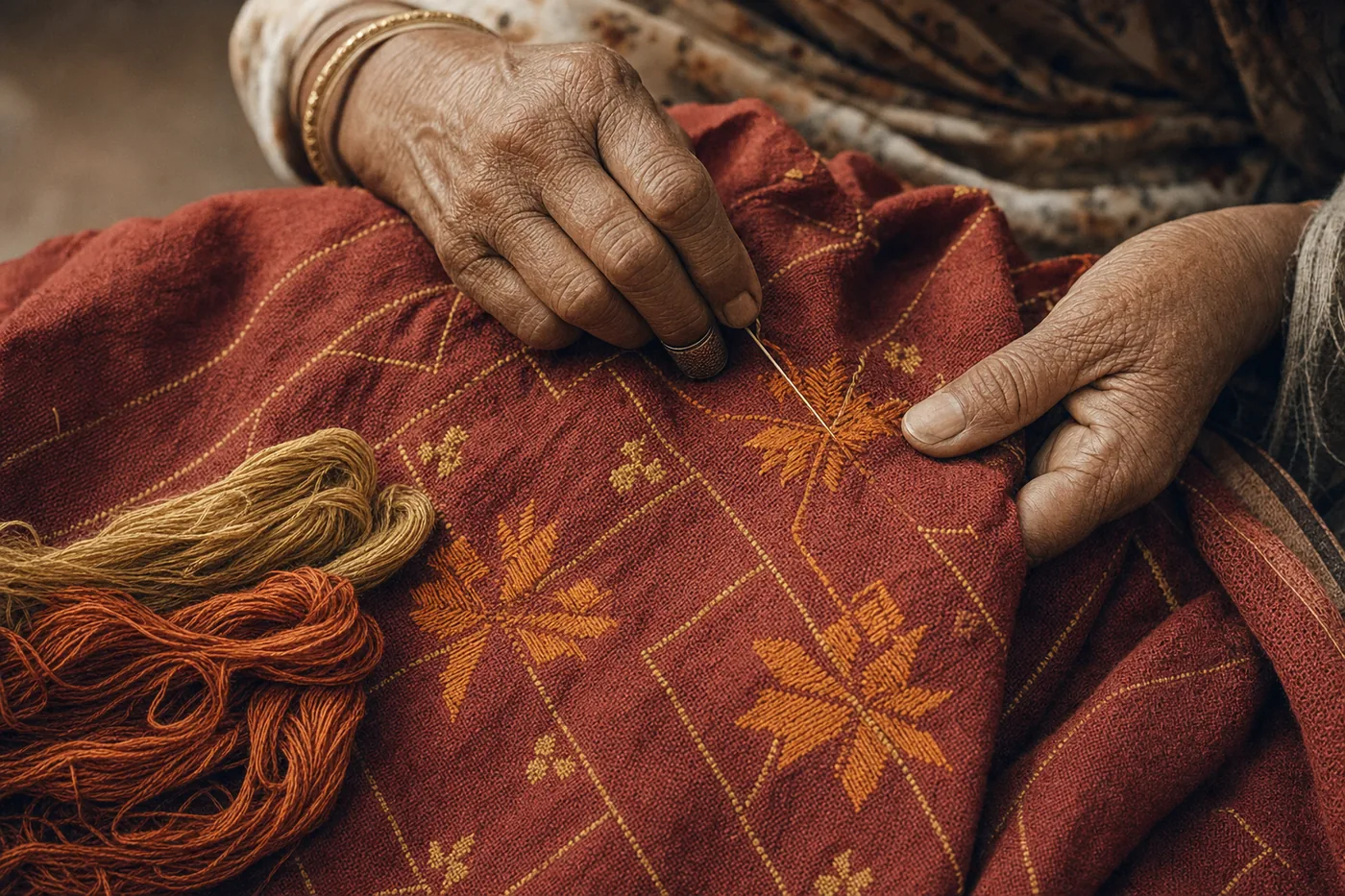
What a chope is
A chope (ਚੋਪ) is a specific form of phulkari — worked in a single colour of soft silk floss thread (pat), stitched with a two-sided counted stitch on hand-woven cotton khaddar so that both sides look almost identical. Traditionally the chope was a deep gold pat on a red or maroon khaddar, though variations in pink, orange, and antique gold are also known.
The chope was not a garment — it was a blessing cloth. A grandmother would begin stitching her granddaughter's chope from the day the granddaughter was born, and continue over eighteen or twenty years, until the girl was married. On the morning of the Anand Karaj at the gurdwara, the chope was draped over the bride's shoulders — most often by the maternal grandmother herself, or in her memory. The bride carried the chope during the four laavan (circumambulations) around the Sri Guru Granth Sahib. It was the physical presence of her nanaki (maternal grandmother's) blessing.
How the chope stitch is different from other phulkari
The stitch is worked so that thread appears on both sides of the khaddar — a "reversible" or "double-sided" stitch. Bagh and standard phulkari are one-sided (the reverse shows only knots and thread ends). Chope shows the motif fully on both sides.
The stitch is slower — perhaps a third of the speed of a one-sided phulkari. A real chope, worked at grandmother-evening pace, took eighteen to twenty years. A chope worked full-time by a single karigar today takes 300 to 400 hours — nearly two months of daily work by one hand.
The colour of a chope
Traditional chope was:
- Deep gold pat — the most-loved chope colour in Punjab. Gold on red khaddar. Reads as pure blessing.
- Antique gold pat — for a chope carried by a more subtly-dressed bride. Reads as inherited wealth without loudness.
- Bandhani pink pat — for Kurmai and Roka chopes, not the Anand Karaj itself.
Modern chopes have appeared in ivory, dusty rose, and even mint — for the bride who wants the ritual meaning without a traditional red base. TEEYAN honours these variations if that is what the family asks for.
Where a chope is placed in a Sikh wedding
The bride carries her chope through:
- Nanaki chak — the maternal grandmother's ceremony, often the evening before the wedding, where the chope is formally handed over.
- Anand Karaj — draped across the bride's shoulders during the four laavan around the Guru Granth Sahib.
- Doli — carried with the bride when she leaves her maternal home.
- First Karva Chauth — some brides carry the chope for their first Karva Chauth after the wedding, honouring the blessing.
TEEYAN's chope service
We work three types of chope:
- Full traditional chope — 300 to 400 hours of one karigar's work, in deep gold pat on red or maroon khaddar. This is the piece that goes to the gurdwara. Commissioned only for brides.
- Chope-inflected dupatta — heavy chope borders on the dupatta for a full-suit commission. Rich, meaningful, less than a full chope.
- Restoration chope work — if you have an old family chope needing careful repair before your Anand Karaj, we consult with our karigars in Patiala. We do not sell restored antique chopes; we only restore chopes owned by the family.
A full chope commission needs at least six months from confirmed measurements to Anand Karaj. If your wedding is in less than six months and you want a chope, we will be honest — we can only offer the chope-inflected dupatta, not the full piece.
What a chope is not
A chope is not a fashion dupatta. A chope is not machine-embroidered gold work sold at wedding shops as "chopa." A chope is not something one buys because it "looks like a chope." A chope is a specific ritual object carrying specific weight — the maternal grandmother's counted stitches, the two-sided phulkari, and the physical presence of a lifetime of prayer.
If you are commissioning a chope from TEEYAN, we will ask about your family, your grandmother, your ceremony. This is not a garment. This is a ritual object. We take it seriously ji.