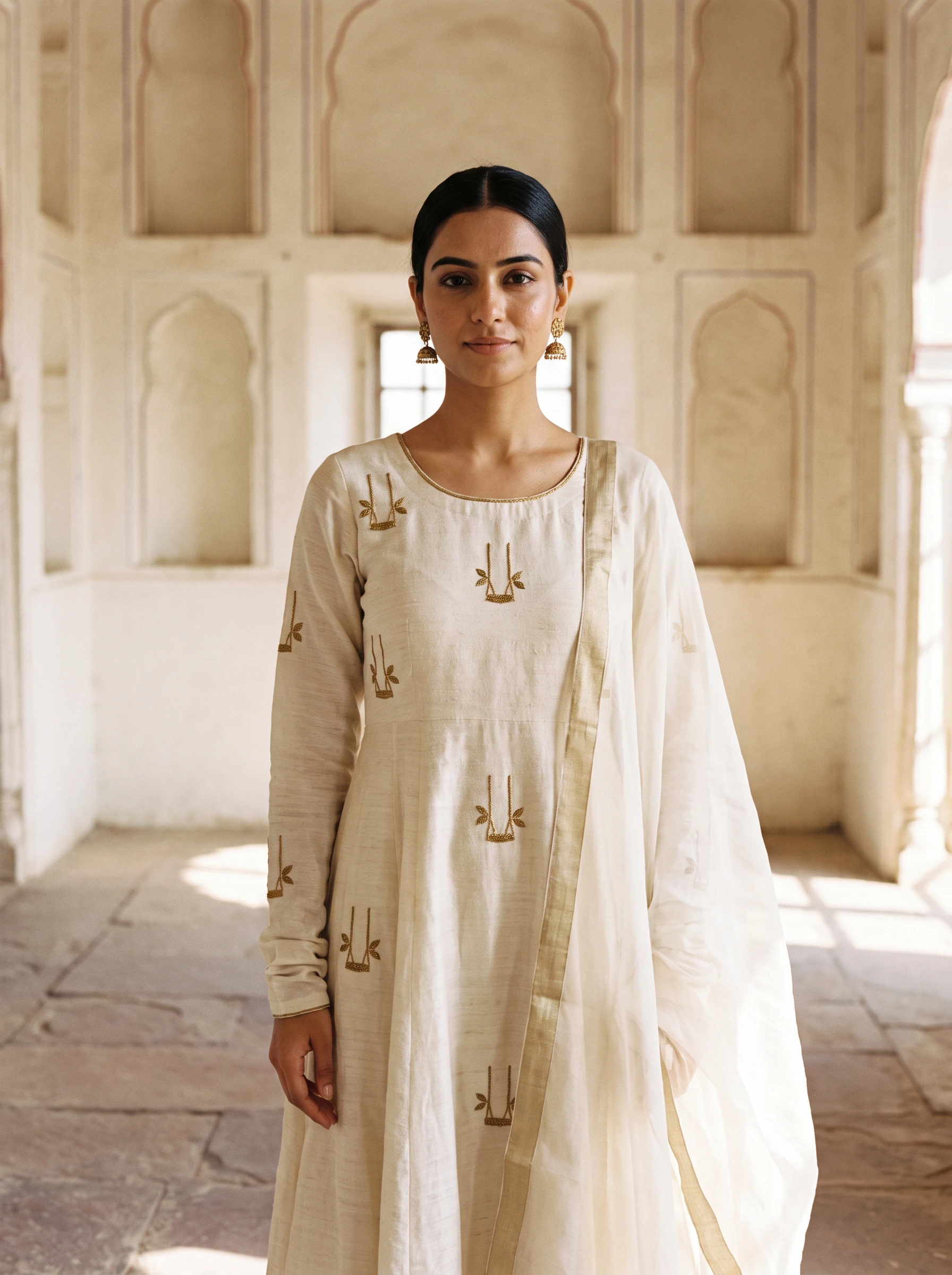
What a phulkari punjabi suit actually is
A phulkari punjabi suit is a Punjabi women's three-piece garment — kurta, salwar or palazzo, and dupatta — worked in real counted-stitch phulkari embroidery. Not printed. Not machine-embroidered. Not "phulkari-inspired." A real phulkari is one soft silk floss thread, pulled through a hand-woven cotton or silk khaddar, one small counted stitch at a time.
Most fabric sold today online and in shops as a "phulkari suit" — including on the largest marketplace sites — is a machine-printed or machine-embroidered fabric with polyester floral motifs. That is a phulkari-inspired product. It is not a real phulkari.
The three phulkari forms most-often used in a punjabi suit
Bagh (garden) phulkari
Bagh means "garden" — a phulkari worked so densely that no khaddar shows beneath. Historically a bagh was made over six to ten years of one grandmother's evening work and given at her granddaughter's wedding. A real full-bagh suit today is a museum piece. TEEYAN offers bagh-adjacent suits — dense phulkari over the yoke, hem, and dupatta — worked in 180 to 240 hours by one hand.
Chope phulkari
Chope is a single-colour, two-sided phulkari — traditionally worked in deep gold pat thread on red khaddar, and draped on a bride during her Anand Karaj at the gurdwara. The chope was the phulkari of blessing, stitched by the maternal grandmother from the day her granddaughter was born. When we work chope on a modern suit, we work it as a heavy border on the dupatta.
Darshan Dwar phulkari
Darshan Dwar means "gate of blessing" — a phulkari carrying arches, small doorways, and sometimes tiny human figures. Made as a thanksgiving piece after a prayer was granted. Rare in modern commissions. If you commission a Darshan Dwar-style piece from TEEYAN it is worked on the dupatta, honestly credited as darshan-dwar-inspired.
How to spot a real phulkari suit
- Turn it over. Real phulkari has visible thread work on the reverse — small knots, thread ends. A print or machine embroidery has a clean, backed reverse.
- Feel it. Real counted phulkari sits a fraction above the fabric surface — you feel it with a fingertip. A print is flat.
- Look at the stitch corners. A hand phulkari has microscopic imperfection at every direction change. A machine phulkari has geometrically perfect corners.
- Ask the karigar's name. A real phulkari house names the woman or the karigar who worked it. A commodity seller cannot.
What TEEYAN's phulkari punjabi suits are
Every TEEYAN phulkari is a real counted stitch, worked by hand in Malwa or in Patiala, on hand-woven cotton khaddar or silk khaddar. The pat (floss silk) thread we use is from a Ludhiana pat mill — the same mill our karigars' grandmothers used.
Our current phulkari-worked suits:
- Peengh — counted-stitch phulkari at the yoke and dupatta hem. Named after the Sawan swing. 80 to 120 hours of phulkari alone.
- Gulabi Dhup — dusty rose base with phulkari-inflected dabka + moti; suited for a Roka or a Karva Chauth.
- Custom-commission phulkari — if you want a specific bagh or chope density on any suit, we will quote it honestly with karigar-attributed hours.
Where phulkari is worn
A phulkari punjabi suit is the traditional wardrobe for:
- Teeyan / Teej festival gatherings (August, Sawan)
- Roka, Kurmai, and Sagai ceremonies (family engagement rituals)
- Rakhi and Lohri family gatherings
- An Anand Karaj gurdwara ceremony (chope, specifically)
- Diaspora Punjabi cultural events — Teeyan Da Mela, Vaisakhi parades, Punjabi Cultural Association evenings
- Any afternoon where a Punjabi woman wants to be seen by her own community wearing her own craft honestly
The made-to-measure and duties-paid commission
Every TEEYAN phulkari suit is made to measure — twelve measurements taken on the first WhatsApp call, kept for life, no need to re-measure for future commissions. Delivery is duties-paid to Canada, the USA, the UK, the UAE, Australia and India. Timeline is six weeks for a standard phulkari density, ten to twelve weeks for a bagh-adjacent full-coverage piece.