What Teeyan actually is
Teeyan (ਤੀਆਂ) is the Punjabi women's festival of Sawan — the monsoon month, when the earth turns green after months of heat and every married daughter returns to her maternal home. It falls on the third day of the bright half of Sawan (Shukla Paksha Tritiya), usually late July or early August. In 2027 it falls on August 5.
The word carries its meaning in its plural form. Teej means "third" — the third day. But in Punjab women say Teeyan, plural, because the celebration is never one day. It is many. Sawan is a season of pinghs and giddha, and Teeyan is the day it comes to a peak.
The three things every Teeyan has
The pingh · ਪੀਂਘ
A rope swing tied high on a peepal or banyan tree, wide enough for two women to sit facing each other. In the old villages of Malwa and Majha, the swings would go up in every courtyard on the first day of Sawan and come down only after Rakhi. Girls competed to swing highest. Married daughters, back at their mother's house, swung on the same swing they had as children. The pingh is what Sawan sounds like: the creak of rope, the peal of laughter, the boli called out mid-air.
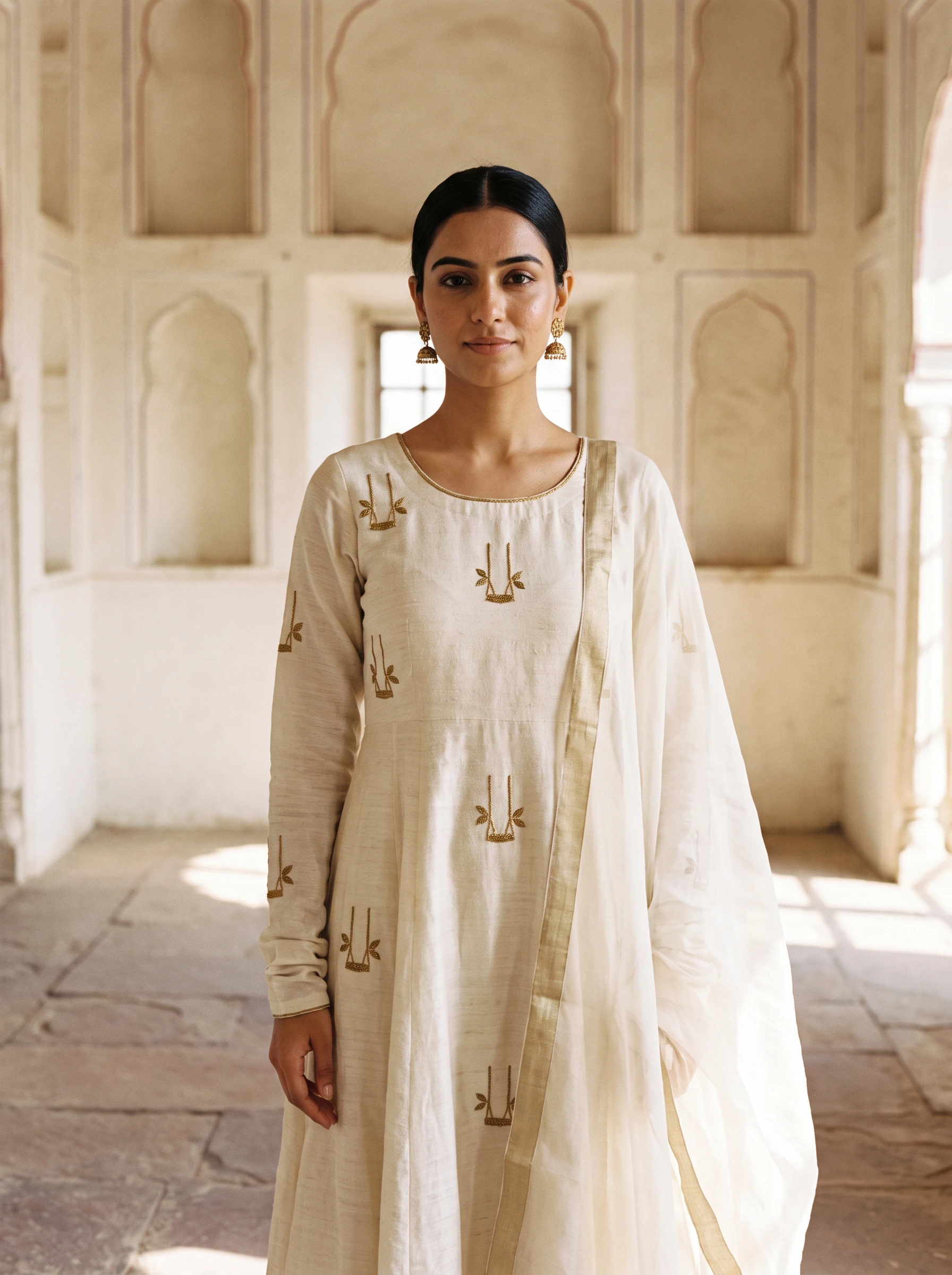
Our suit named Peengh is a homage to this — a phulkari-worked suit for the woman who still remembers the swing.
Giddha · ਗਿੱਧਾ
Punjabi women's folk dance — a circle, clapping, and one woman at a time stepping in to sing a boli: a witty two-line couplet, often teasing an in-law, a husband, a sister-in-law. Giddha is where Punjab's women have always said the things the culture wouldn't say out loud. On Teeyan the giddha starts at afternoon and lasts until moonlight.
The suit · ਸੂਟ
What every Punjabi woman wears to Teeyan is a bright suit — the brighter the better, because Sawan is bright. Phulkari at the yoke and hem. Mustard, deep pink, parrot green, and the red of gulmohar. The parandi in the hair, jhumkas at the ears, gajra on the wrist. This is not the muted "quiet luxury" wardrobe of a New York private view. This is the wardrobe of a village afternoon in August, where the women are seen by their own.
Teeyan Da Mela — how the festival crossed the ocean
The diaspora carried Teeyan out of Punjab. In the 1990s the first Punjabi Women's Cultural Association melas began in Vancouver and Toronto — public celebrations of Teeyan in city parks, drawing hundreds, then thousands.
Today Toronto's Teeyan Da Mela at Woodbine Racetrack is one of the largest single gatherings of Punjabi women in North America — regularly ten thousand attendees on the first Sunday of August. Surrey, BC holds its Teeyan at Bear Creek Park. Southall in West London has held Teeyan on Ealing Road since 1998. Melbourne, Sydney, Perth all have their melas now. In every one of them, the same thing happens: women arrive in their finest phulkari suits, take the stage in groups of eight or ten, and give giddha to the crowd.
What to wear to Teeyan — a guide from the house
If you are attending Teeyan Da Mela in Toronto, Surrey, or Southall this year, or a private Teeyan gathering at your mother's house, this is the honest guidance from a Punjabi atelier:
Colour
Sawan colours. Bright fuchsia pink, mustard yellow, gulmohar red, parrot green, orange. If your mother has strong preferences, follow them — Teeyan is a festival of her generation as much as yours. Avoid muted neutrals unless the phulkari itself carries the warmth.
Silhouette
Any Punjabi silhouette works — anarkali, salwar kurta with palazzo, or a light gharara. Avoid heavy bridal ghararas or lehengas — Teeyan is a day of movement and dance, not a wedding sit-down. If you plan to give giddha, wear a suit with lightweight cotton or silk khaddar so you can move.
The craft
Phulkari, always, if the budget allows — the yoke, the hem, the dupatta border, or a full phulkari dupatta over a plain kurta. Real counted-stitch phulkari, not printed. If not phulkari, then tilla work or a light zardozi border. Teeyan is the one day a Punjabi woman's phulkari earns its keep.
The accessories
Parandi in the braid. Jhumkas — mid-weight, not chandelier. Gajra on the wrist (real jasmine if you can get it). Simple maang tikka only if you are unmarried and going with your sisters. A small red bindi. Kolhapuri or juti on the feet — you will be dancing.
The house of TEEYAN, named for the festival
We named the house TEEYAN because the festival is what a Punjabi woman's suit is for. Not for a magazine cover. Not for a stranger's algorithm. For the mother's courtyard, and the pingh, and the giddha, and the ten thousand women in Toronto in August who arrive dressed like their grandmothers dressed and are seen by their own.
Every suit in the house is cut for a Punjabi woman first. If you are commissioning a suit for Teeyan Da Mela — Toronto, Surrey, Southall, Melbourne, or your mother's own courtyard in Ludhiana — we would be honoured to work with you. Peengh, Gulabi Dhup, and Kesar are the three suits in our house most often chosen for Teeyan.
The Punjabi diaspora's Teeyan calendar — 2027
- Toronto — Teeyan Da Mela, Woodbine Racetrack, first Sunday of August (Aug 1, 2027 expected)
- Surrey, BC — Bear Creek Park Teeyan Da Mela, early August (dates published by PWCA every June)
- Southall, London — Ealing Road Teeyan, late July / early August
- Melbourne — Punjabi Cultural Association Teeyan, first Sunday of August
- New Jersey / Bay Area — regional Teeyan celebrations organised by Sikh Cultural Society chapters
- Punjab — Teeyan itself falls on August 5, 2027 (Shukla Paksha Tritiya of Sawan)
If you are planning your Teeyan suit for 2027, commissions should begin by early April 2027 to allow six weeks for made-to-measure and phulkari time.