ਘਰਾਰਾ
The Gharara.
Two knee-bands, one lineage.
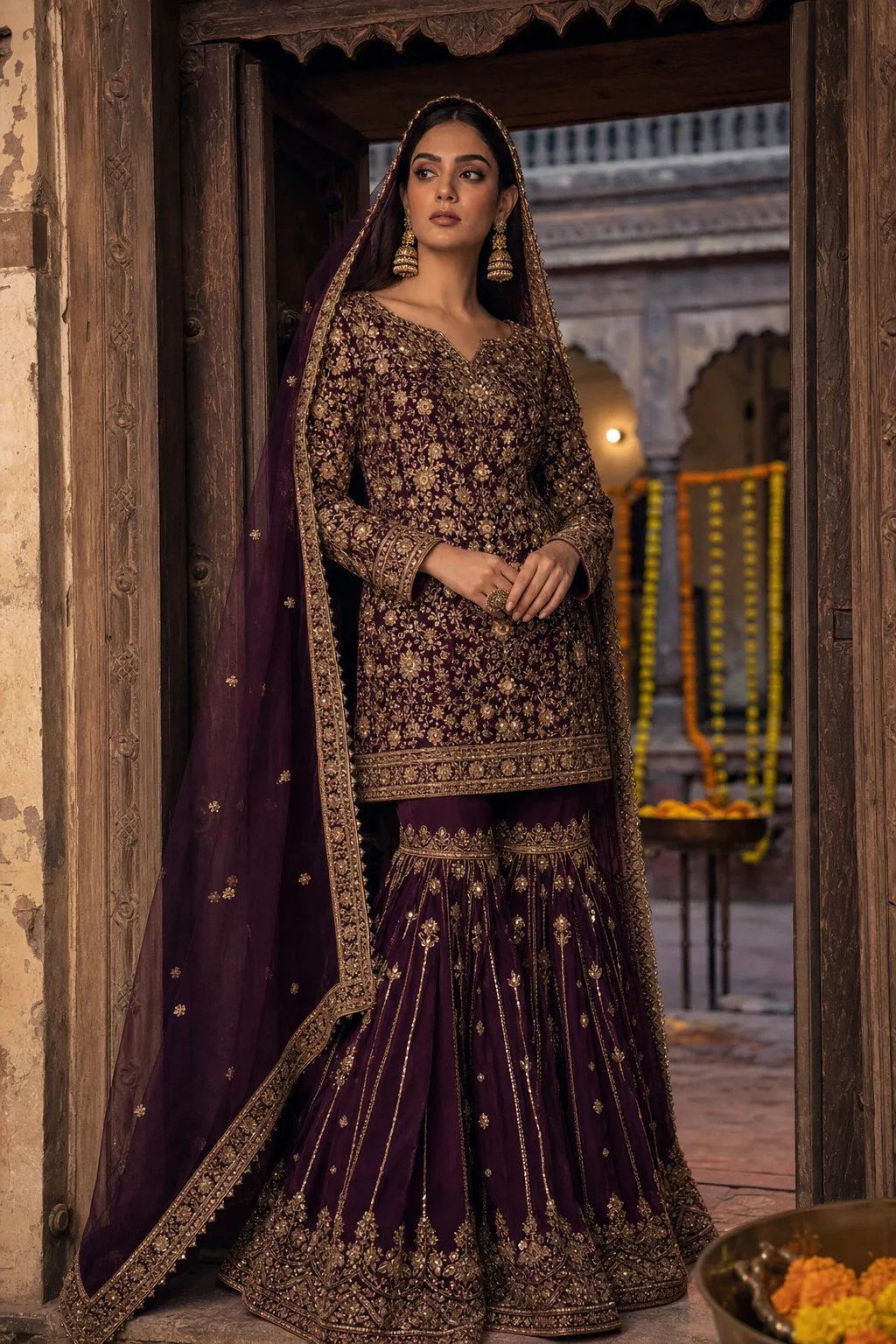
A gharara (ਘਰਾਰਾ) is a Punjabi silhouette of two wide, flared trousers meeting at the knee in a heavy embroidered band called the aara. Below the aara, the fabric opens into a wide bell — up to seven metres of silk per leg. Above the aara, it fits close to the thigh.
The gharara is not a Punjabi invention alone — it travelled from Awadhi (Lucknowi) courts through Mughal and Nawabi households into North Indian bridal wardrobes. In Punjab, it became the silhouette of the Sangeet and Mehndi hours, worn with a heavily worked kurti and a soft dupatta.
At TEEYAN we make the gharara the way it was made in old ateliers — the aara stitched by hand over solid canvas backing, so it does not sag or roll. Each aara alone takes 40 to 90 hours of hand karigari.
Two flared trousers with an embroidered knee-band (aara). Fitted above the knee, flared below. Formal, heavy, bridal.
Two flared trousers without the knee-band. Flares from the waist or hip down. Lighter, easier to walk in. Cocktail and reception.
Straight or slightly flared trousers with no knee-band and no dramatic bell. Modern, everyday. Mehndi and sangeet on lighter days.
The gharara's traditional home. Move, dance, sit cross-legged — the aara holds its shape.
Lighter ghararas in yellows, saffrons, or dusty rose. The heavier aara comes out for evening.
Deep colours — plum, oxblood, ink teal. Full zardozi aara. Photographed under warm lights.
Some brides choose a gharara over a lehenga for the ceremony itself — especially in Punjabi-Muslim and Punjabi-Awadhi families.
A plum silk gharara with hand zardozi and gota patti — our house gharara.
See the Jamun →A gharara is a two-piece Punjabi and North Indian trouser silhouette with an embroidered knee-band (aara) that separates the fitted thigh from the wide flared bell. It is traditionally paired with a short embroidered kurti and a soft dupatta.
A gharara has an embroidered knee-band (aara) — a sharara does not. A sharara flares from the waist or hip down in one continuous line. A gharara is heavier, more formal, and traditionally bridal. A sharara is lighter and easier to walk in.
A traditional Punjabi bridal gharara uses between five and seven metres of silk per leg — so ten to fourteen metres for the trousers alone, plus fabric for the kurti and dupatta. This is why the silhouette holds its bell shape.
Once the aara is stitched over proper canvas backing, the gharara sits and moves beautifully. TEEYAN's ghararas are built to be worn through a full evening of sitting, standing, and gidha dancing without shifting.
Every TEEYAN gharara is bespoke — made to your measurements, in the fabric, colour, and embroidery you choose. Price on request over WhatsApp. Duties-paid delivery to Canada, USA, UK, UAE, Australia and India is included.
A TEEYAN gharara takes 10 to 14 weeks depending on the density of the aara embroidery. The aara alone is 40 to 90 hours of hand karigari before the trousers are constructed.
We do not fill forms. Every TEEYAN gharara is made for one woman — WhatsApp us to speak about fabric, colour, karigari, and your date.
WhatsApp · +91 94920 00054