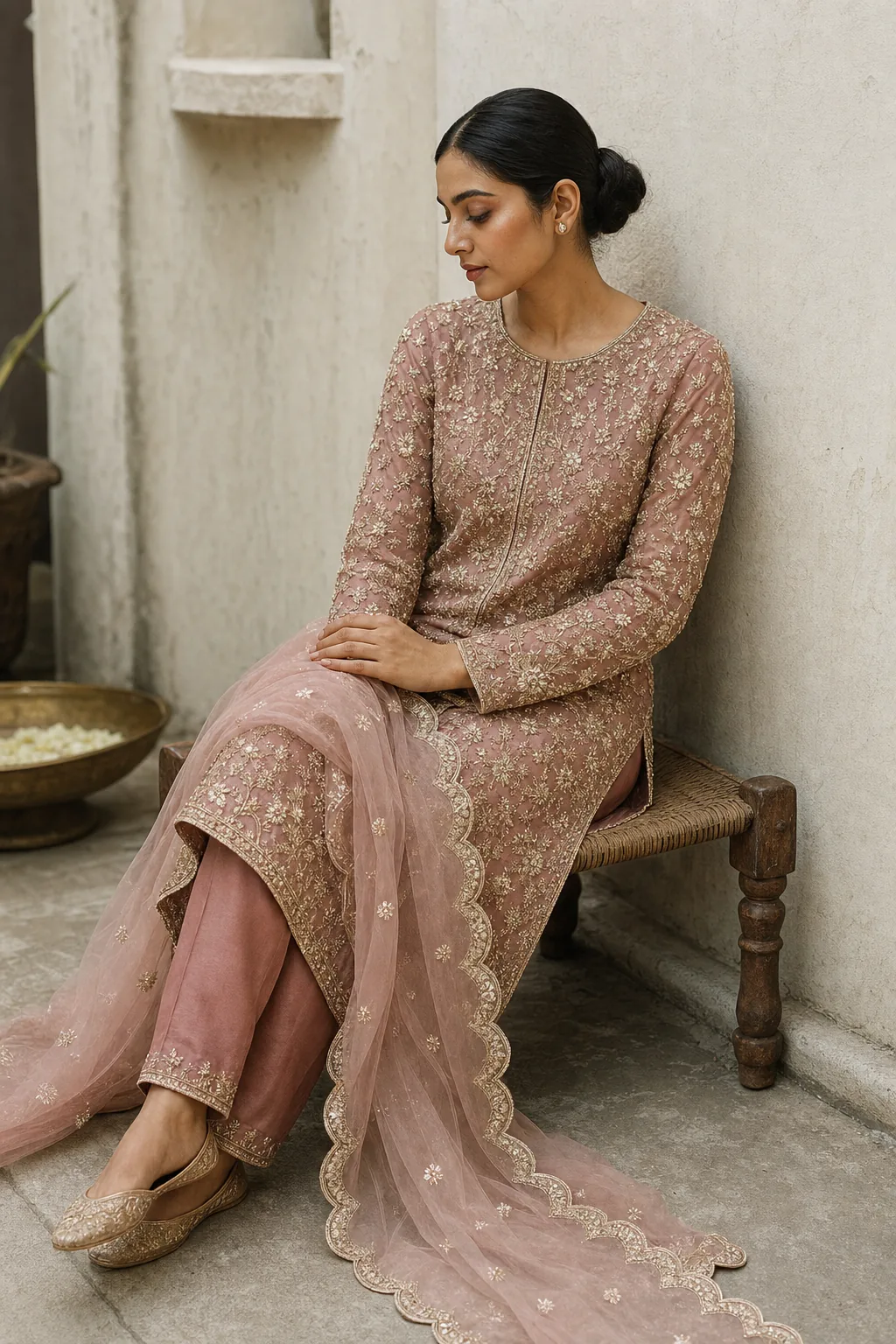
What Sandhara is
Sandhara (ਸੰਧਾਰਾ) is the Punjabi tradition of sending gifts from a maternal home to a married daughter's marital home — most often around Teeyan, Karva Chauth, Diwali, or a first-year milestone. In old Punjab, Sandhara was carried by the mother's brother (mama) in a wicker basket, walked or bicycled from village to village. Today, in the diaspora, Sandhara is often couriered from Ludhiana or Amritsar to Toronto, Surrey, or London, arriving weeks before the festival it is meant for.
The word carries the meaning of a message — sandesh, news, blessing. A Sandhara says: your maternal family has not forgotten you. You are still ours, even in your husband's house.
What is traditionally in a Sandhara
A traditional Punjabi Sandhara carried:
- A suit — one, occasionally two, always Punjabi, always with the daughter's known preferences (colour she likes, silhouette she wears, karigari her hands remember from her mother's).
- Mithai — home-made ladoo, pinni, or besan barfi. In the diaspora, this is often replaced by a box from a Punjab-specific mithai shop.
- Jewellery — a small piece, often a jhumka, a nose-ring, or a bracelet. Not a large purchase; a token.
- A small envelope of shagun — a token amount of money, always an odd figure (₹1,001, ₹5,001), for blessing.
- A hand-written note or card — from the mother, in Gurmukhi if she can, otherwise in Punjabi-transliterated English. Two or three lines only.
Sandhara occasions in the Punjabi calendar
Teeyan Sandhara
The most-celebrated Sandhara — sent for the daughter to wear at Teeyan Da Mela in her diaspora city. The suit inside is almost always phulkari-worked, in bright Sawan colours. Sent to arrive by mid-July for the first Sunday of August.
Karva Chauth Sandhara
For a daughter's Karva Chauth in the marital home. The suit is typically a deeper tone — maroon, oxblood, saffron — with heavier karigari. Sent to arrive by mid-September for October Karva Chauth.
Diwali Sandhara
Around October–November. Suit, mithai, and a small jewellery piece. Historically carried by the mama; today most-often couriered.
Pehla Saal (First Year) Sandhara
For a newly-married daughter's first Teeyan, first Karva Chauth, first Diwali, first Lohri after her wedding. This Sandhara is larger — often two suits, more mithai, sometimes a bangle set. It is the first year, and the maternal home is showing that the daughter has not left them.
The modern diaspora Sandhara
Most maternal families in Punjab today cannot physically visit their daughters in Canada, the UK, or Australia. TEEYAN sees Sandhara commissions every month from mothers in Amritsar, Ludhiana, Jalandhar, and Chandigarh — for daughters in Toronto, Vancouver, London, Melbourne, and New Jersey.
How the diaspora Sandhara works with us:
- The mother tells us on WhatsApp what her daughter likes — colours, silhouettes, whether she wears bright or muted, whether she carries a phulkari well.
- The daughter's twelve measurements are taken over a video call from her home city (Toronto, Surrey, London), by our client advisor.
- We send photographs of the suit at the karigari stage — mid-embroidery — to the mother, so she can see her daughter's suit being made.
- We ship duties-paid to the daughter's address in Canada, USA, UK, UAE, Australia, or across India — with a hand-written card from the mother in Gurmukhi (or Roman Punjabi), sealed inside the packaging.
- The daughter opens the parcel at her own home and knows: her mother has not forgotten her.
Sandhara timelines — commission before the festival
Realistic timeline for a Sandhara commission that arrives on time:
- Teeyan Sandhara (August festival) — commission by early June.
- Karva Chauth Sandhara (October) — commission by mid-August.
- Diwali Sandhara (October–November) — commission by early September.
- Pehla Saal Sandhara (first-year milestone) — commission at least eight weeks before the occasion.
TEEYAN suits most-chosen for a Sandhara
- Peengh — the most-chosen Teeyan Sandhara suit. Phulkari, bright, movement-friendly.
- Gulabi Dhup — the most-chosen Karva Chauth Sandhara suit. Dusty rose, dabka, photograph-ready.
- Kesar — Roka and Sagai Sandhara. Saffron, phulkari-worked, formal but not bridal.
- Ambi — the most-chosen Pehla Saal (first-year) Sandhara suit. Restrained, elegant, a daughter's day-suit.
The card that goes with the Sandhara
Every Sandhara sent through TEEYAN can include a hand-written card — the mother writes what she wants to say, we transcribe it (in Gurmukhi if she wishes, or in Roman Punjabi), print it on hand-made deckle paper from Ludhiana, and seal it inside the packaging. This is not an add-on; this is the whole point.