Why the confusion, ji
Walk into any Punjabi wedding shop and ask for a "gharara" — half the time the shopkeeper will show you a sharara. Ask for a "sharara" and he might bring out a palazzo. Ask for a "palazzo" and someone might call it a "plazo suit". The lines between these three silhouettes have blurred so much that most brides commission the wrong thing.
At TEEYAN we take these words seriously — because our karigars do. A gharara is not a sharara. A sharara is not a palazzo. Each silhouette is a different story, a different construction, and a different hour of your wedding week. Let us walk through all three, honestly, one at a time.
The Gharara · ਘਰਾਰਾ
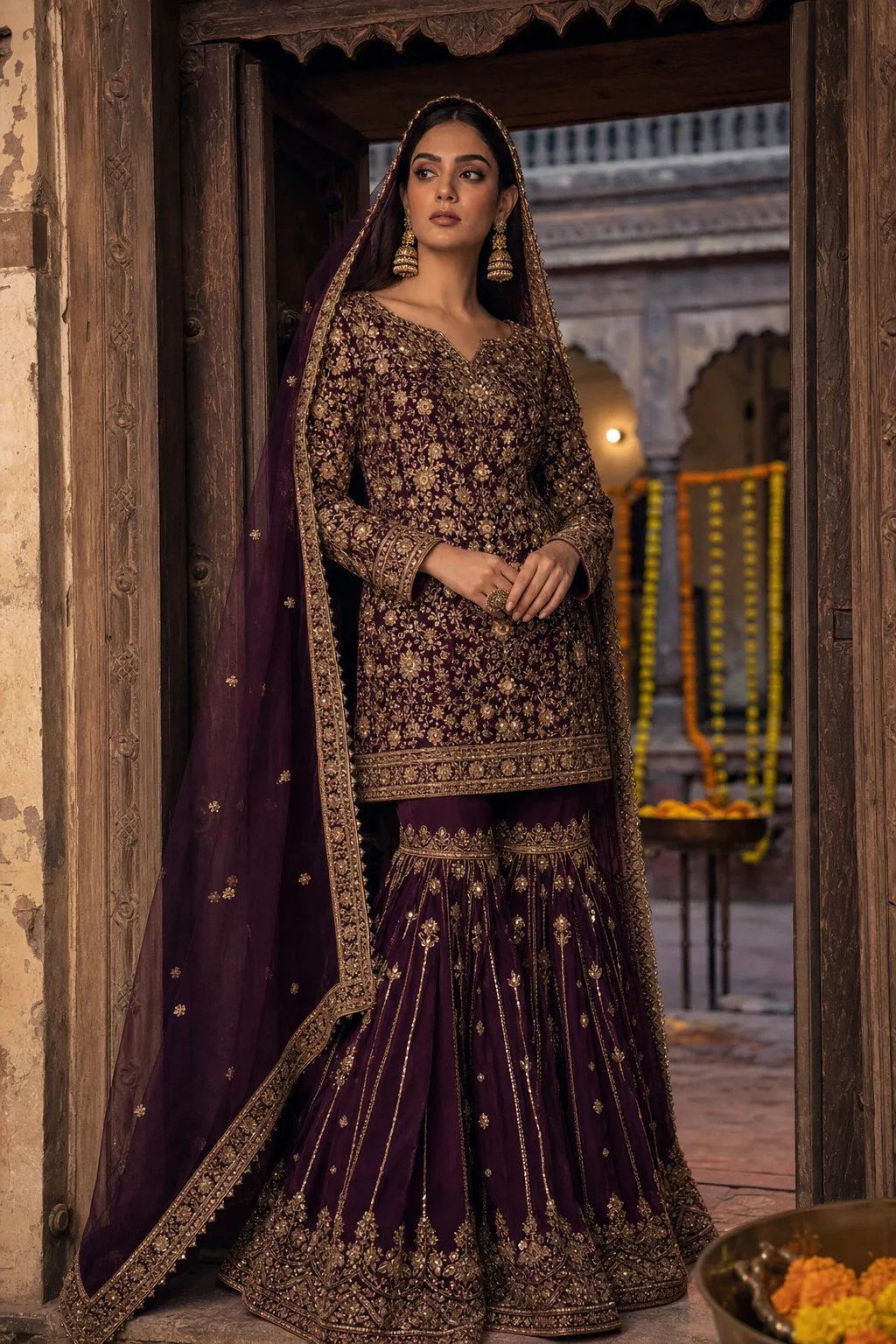
A gharara is a two-piece trouser silhouette with an embroidered knee-band called the aara. The trouser fits close to the thigh above the aara and opens into a wide, dramatic bell below. The aara is the whole point — a solid canvas-backed band, heavily embroidered by hand, that separates the fitted top from the flared bottom.
The gharara did not originate in Punjab. She travelled from the courts of Awadh (Lucknow) through Mughal and Nawabi households into Punjabi bridal wardrobes over the last three centuries. In Punjabi families she became the silhouette of the Sangeet and Mehndi — the hour when a bride wants to dance without her clothes shifting.
Fabric: Five to seven metres of silk per leg. Plus two to three for the kurti and three to four for the dupatta. A traditional gharara uses fifteen to twenty metres of fabric in total.
Karigari: The aara alone is 40 to 90 hours of hand zardozi, dabka, or gota patti. Add the kurti neckline, hem, and dupatta border — total karigari is 200 to 280 hours per gharara.
Best for: Sangeet, Mehndi, Reception. Some Punjabi and Punjabi-Muslim brides also choose a gharara for their Nikaah or Anand Karaj.
TEEYAN's gharara: Jamun — plum silk, hand zardozi and gota patti on the aara.
The Sharara · ਸ਼ਰਾਰਾ
A sharara is also a two-piece trouser silhouette — but there is no aara. The fabric opens from the hip or high thigh down to the floor in one continuous line. The line is uninterrupted. She is lighter than a gharara, softer than a lehenga, and easier to walk in than either.
The sharara is the sharara of Nawabi cocktail evenings, of dhol-heavy Punjabi receptions, of the elder sister who wants presence without her waistband cutting in. She photographs beautifully because that one long line uninterrupted from hip to hem is what the human eye trusts.
Fabric: Four to six metres of silk per leg. Two to three for the kurti. Three for the dupatta. Ten to fourteen metres total.
Karigari: 140 to 200 hours. Less than a gharara because there is no dense aara to hand-stitch — the karigari lives on the yoke, the hem, and the dupatta edge.
Best for: Cocktail, Reception, Sangeet, Roka, Chunni Chadhai. Also for mothers of the bride who want to be photographed like brides themselves.
TEEYAN's shararas: Kaudi — ivory silk with cowrie and pearl work. Gulabi Dhup — dusty rose with dabka and moti jaal.
The Palazzo · ਪਲਾਜ਼ੋ
A palazzo is the modern, quiet cousin of the gharara and sharara. Wide-leg, straight or slightly A-line trousers, worn with a kurti and a soft dupatta. No dramatic bell. No knee-band. No flare from the hip. Just clean lines from waist to ankle.
The palazzo entered Punjabi wardrobes in the 2000s as the everyday luxury suit — for kitty parties, temple visits, small family gatherings, and modern working women. She does what a salwar does but sits softer against the leg. She is the suit for a Punjabi woman who does not need to be loud.
Fabric: Three to four metres of cotton-silk or heavier silk. Two to three for the kurti. Two to three for the dupatta.
Karigari: 40 to 120 hours. TEEYAN's Kora carries one quiet line of hand marori on the neckline and cuffs — nothing more. Restraint is the whole aesthetic.
Best for: Everyday, Roka, Chunni Chadhai, Mehndi day (for the woman who wants to eat and move without a heavy waistband). Also for mothers and older women who want quiet presence.
TEEYAN's palazzo: Kora — chalk cotton-silk, cropped kurti, cigarette palazzo.
Side by side
| Silhouette | Knee-band? | Flare | Formality | Best hour |
|---|---|---|---|---|
| Gharara | Yes — heavy aara | Bell below knee | Formal, bridal | Sangeet, Mehndi |
| Sharara | No | From hip to floor | Cocktail, wedding | Cocktail, Reception |
| Palazzo | No | Straight or soft A | Modern, everyday | Roka, everyday |
Which one for a Punjabi bride?
Truth ji — most Punjabi brides do not need to choose. The wedding week has enough hours for all three. A common wardrobe:
- Roka / Chunni Chadhai: A palazzo (Kora) or a light sharara — quiet, elegant, comfortable to sit and eat in.
- Mehndi: A saffron or dusty rose sharara — lighter to walk in with mehndi drying on your hands.
- Sangeet: A gharara (Jamun) — the aara holds its shape through gidha and bhangra.
- Anand Karaj: A lehenga, a heavy anarkali, or (for some) a bridal gharara.
- Reception: A sharara (Kaudi) or an anarkali (Nili Raat) — photograph-ready.
Not every bride needs every suit. Some brides commission just one TEEYAN suit and repeat other silhouettes from their family wardrobes. That is honest — and that is what we suggest to most of our brides on WhatsApp before we quote anything.
What we make and what we do not
We make all three silhouettes — gharara, sharara, palazzo — and we also make anarkalis and traditional Punjabi salwar suits. What we do not make is a lehenga. That is not our house. If a bride needs a lehenga we will honestly point her to a house that does lehengas better than us, and stitch the rest of her wedding week from TEEYAN.
The kind of honesty we ask our karigars to hold — a gharara is a gharara, a sharara is a sharara — is the same honesty we hold with brides. If a silhouette is not right for your body, your budget, or your hour, we will say so before we take the deposit.
Speak to us on WhatsApp: +91 94920 00054