Start ji: the honest timeline
An NRI Punjabi bride needs to think in three horizons: the ceremony date, the arrival date, and the karigari clock. Most brides plan around the first and forget the third — which is why so many bridal suits arrive rushed, machine-finished, or short of the promise.
A properly hand-embroidered TEEYAN suit — gharara, sharara, anarkali, or lehenga-adjacent — takes 10 to 14 weeks from the day the karigar begins. Add 1 to 2 weeks for measurement, muslin fitting, and finishing. Add 5 to 10 days for shipping duties-paid to Canada, USA, or UK. That is 15 to 18 weeks total per suit. Add another buffer week for weather or embroidery-thread delays.
So for a July wedding, the bride should start speaking to the atelier by February. For a December wedding, by July. Six months is comfortable. Four months is tight. Three months is emergency-mode. Less than that, we will honestly tell you we cannot deliver.
The wedding week wardrobe
A modern NRI Punjabi wedding usually runs across five to seven functions. Not every bride needs an atelier suit for every function — but understanding what belongs where helps the planning honestly.
1. Roka · ਰੋਕਾ (engagement)
Small, family-only. A palazzo suit or a light sharara — nothing heavy, nothing bridal. Colours: saffron, dusty rose, sage green, ivory. Karigari: 40 to 80 hours. Suggested TEEYAN suit: Kora or Ambi.
2. Chunni Chadhai · Sagai
Larger family gathering. A slightly heavier suit — a light anarkali or a medium sharara. Colours: pistachio, dusty blue, warm oxblood. Karigari: 80 to 120 hours.
3. Mehndi · ਮਹਿੰਦੀ
Yellow-and-green traditional palette. The bride's hands are covered in henna so the suit needs to be comfortable to sit still in for hours. A sharara works better than a gharara here. Colours: saffron, marigold yellow, mustard, pale green. Suggested TEEYAN suit: Gulabi Dhup if the bride prefers pink.
4. Sangeet · ਸੰਗੀਤ
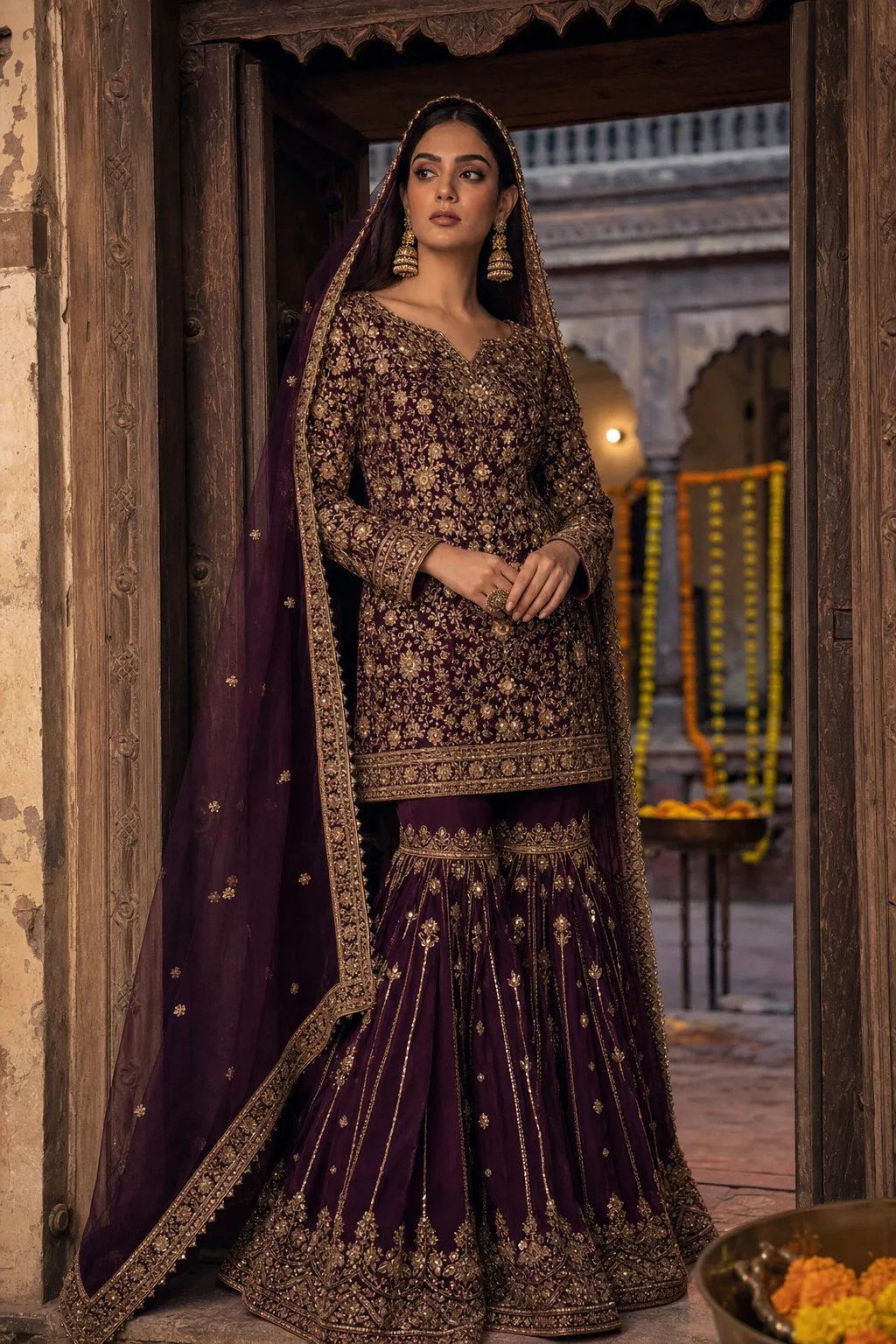
Dance-heavy. The gharara's home hour. Heavy embroidery, deep colour, aara that can withstand gidha and bhangra. Suggested TEEYAN suit: Jamun (plum silk gharara) or Peengh (parrot-green 16-kali anarkali).
5. Anand Karaj · ਅਨੰਦ ਕਾਰਜ (ceremony)
The sacred ceremony. Traditionally a bridal lehenga in red, maroon, or oxblood. Some Punjabi brides now choose a heavy anarkali or a bridal gharara instead. TEEYAN does not make lehengas — but we do make bridal ghararas and heavy anarkalis. Suggested: Nili Raat for a bride who wants depth of colour instead of red, or a custom bridal gharara.
6. Reception · ਰਿਸੈਪਸ਼ਨ
Photograph-heavy, formal, guest-facing. A sharara or a floor-length anarkali in a jewel tone works beautifully. Suggested TEEYAN suit: Kaudi (ivory sharara) or Morni (peacock anarkali).
How measurements work from abroad
Truth ji — most bridal ateliers will not stitch without a physical fitting. We do. We built a remote measurement protocol specifically for NRI brides:
- You measure yourself with a tailor's tape at home — we send a WhatsApp video walking you through 18 body points.
- You send the numbers plus a full-length photo in fitted clothes.
- We stitch a muslin (mock-up) in your size and send you photos of the muslin on our dress-form.
- If anything looks off, we adjust before we cut the real silk.
- The final suit ships duties-paid — we cover import duties to Canada, USA, UK, UAE, and Australia so you receive it without a surprise customs bill.
For brides who can visit Punjab, we do offer an in-atelier fitting week in Mohali. Many NRI brides plan a Punjab trip 8-10 weeks before the wedding for exactly this. If you can visit, we recommend it — but if you cannot, we can still get you within one small alteration of a perfect fit.
The honest cost expectation
We do not publish prices because every suit is bespoke. But here is the honest expectation ji:
- A light TEEYAN suit (Kora, Ambi) — starting in the low range for a proper made-to-measure atelier piece.
- A medium suit (Kaudi, Gulabi Dhup, Neel) — mid-range, with 140-200 hours of hand karigari.
- A heavy bridal suit (Jamun gharara, Nili Raat bridal, Peengh 16-kali) — upper range, with 220-280 hours of karigari.
Every quote is on WhatsApp only. We do not have a form. We do not have a phone tree. We do not have a size chart PDF. Every quote is a conversation, and every conversation gets an honest answer — including "this is more suit than you need" when that is the truth.
What NRI brides get wrong
Three honest observations from our commission conversations with brides in Toronto, Vancouver, London, Edison, Melbourne, and Dubai:
- Ordering too many suits. The average NRI bride commissions six wedding-week suits. Most of them will only be worn once, photographed once, and stored. We usually suggest three TEEYAN suits + reused family suits for smaller functions.
- Choosing colour based on Pinterest. Punjabi bridal photography loves oxblood, plum, deep saffron, and ink teal. Pinterest loves pastel pink and mint. Pick colours that hold on evening light — not on a phone screen.
- Ignoring the ceremony hour. A Sangeet suit that photographs beautifully at 6pm evening light will look flat at 2pm daytime Mehndi. Match the suit's colour weight to the hour of the function.
How to start with TEEYAN
Message us on WhatsApp: +91 94920 00054. Tell us your wedding date, your city, and the functions you are planning. We will honestly tell you if we can fit the timeline, which suits we would suggest, and roughly what the cost band would be. If it is not the right fit, we will say that too.
No forms. No email chains. No pushy sales. Just an atelier conversation, the way our karigars would have done it in the old Patiala workshops.